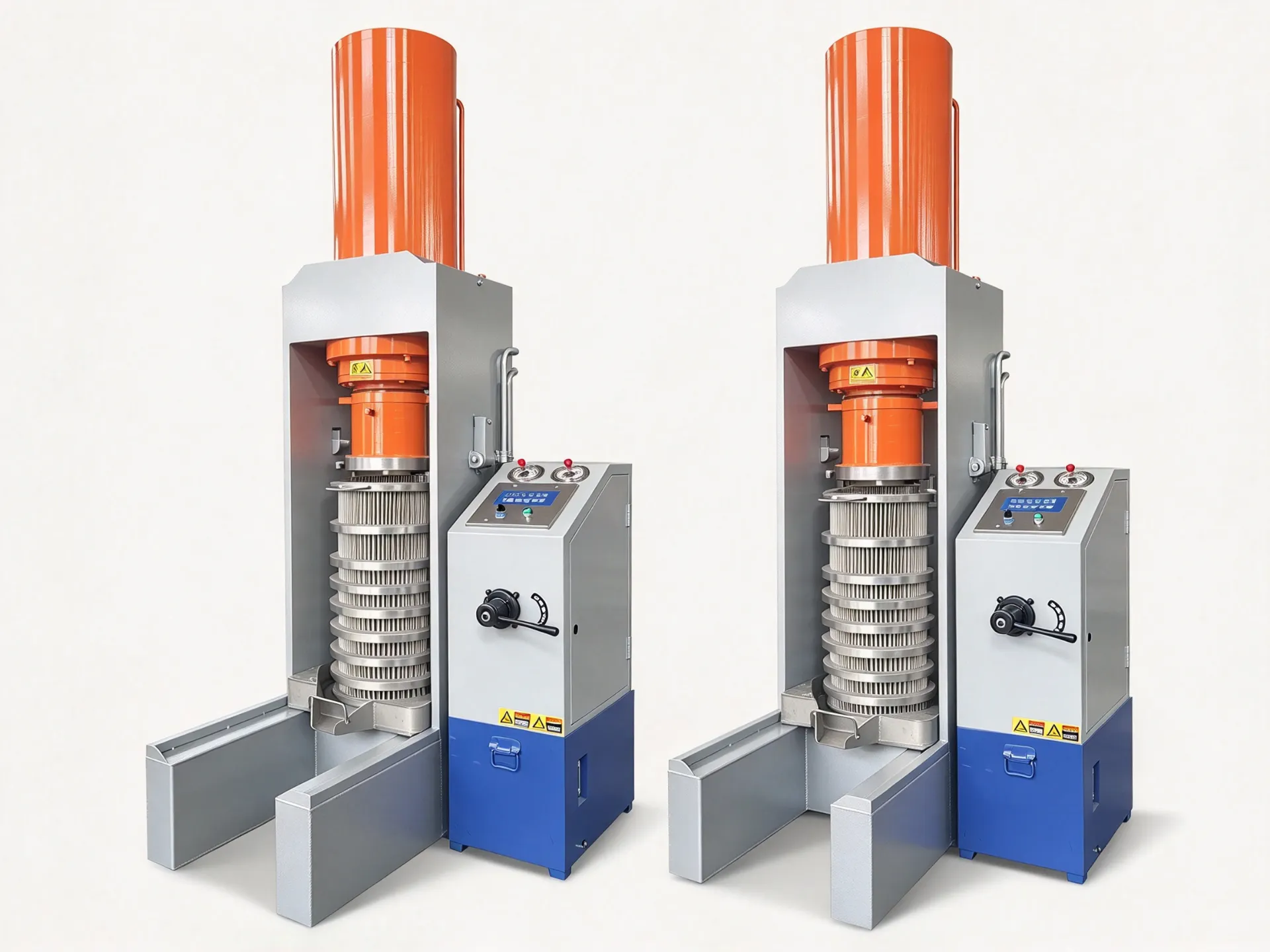
COLD PRESS HYDRAULIC OIL PRESS MACHINE FOR PREMIUM OILS
A 500-ton hydraulic press built for cold-pressed oil businesses. Press without roasting to keep the natural aroma and nutrients in the oil — and switch to hot pressing whenever yield matters more. 70 MPa system pressure, single or double barrel, factory-direct.
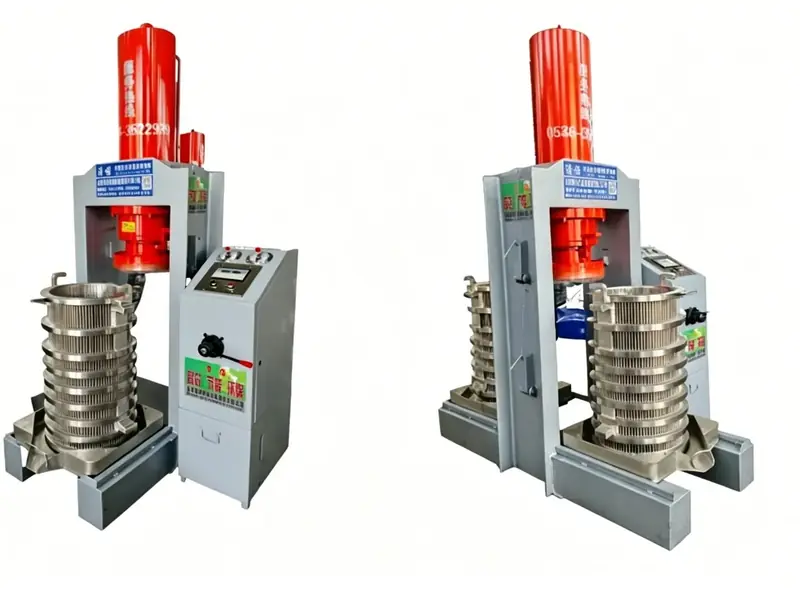
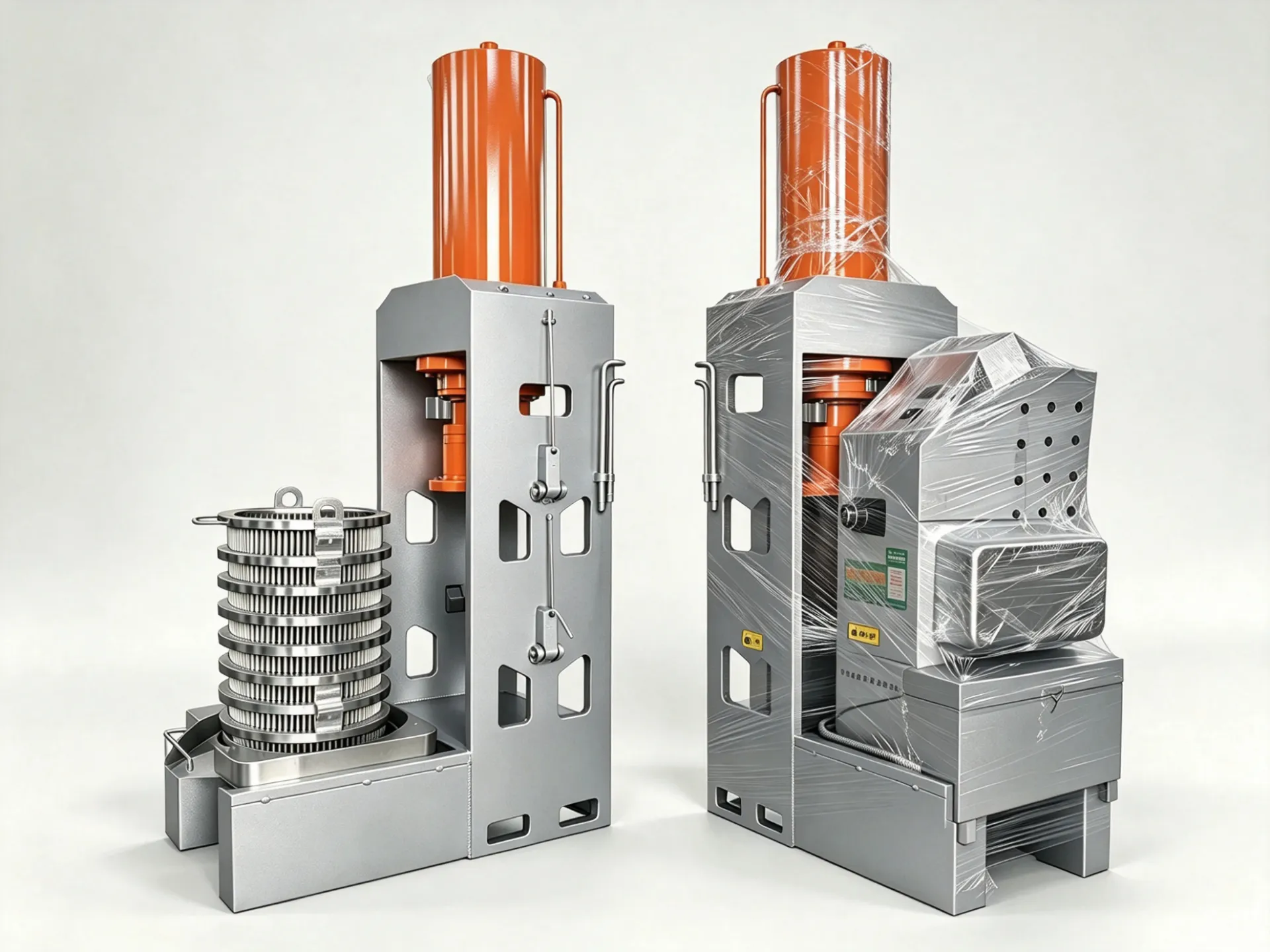
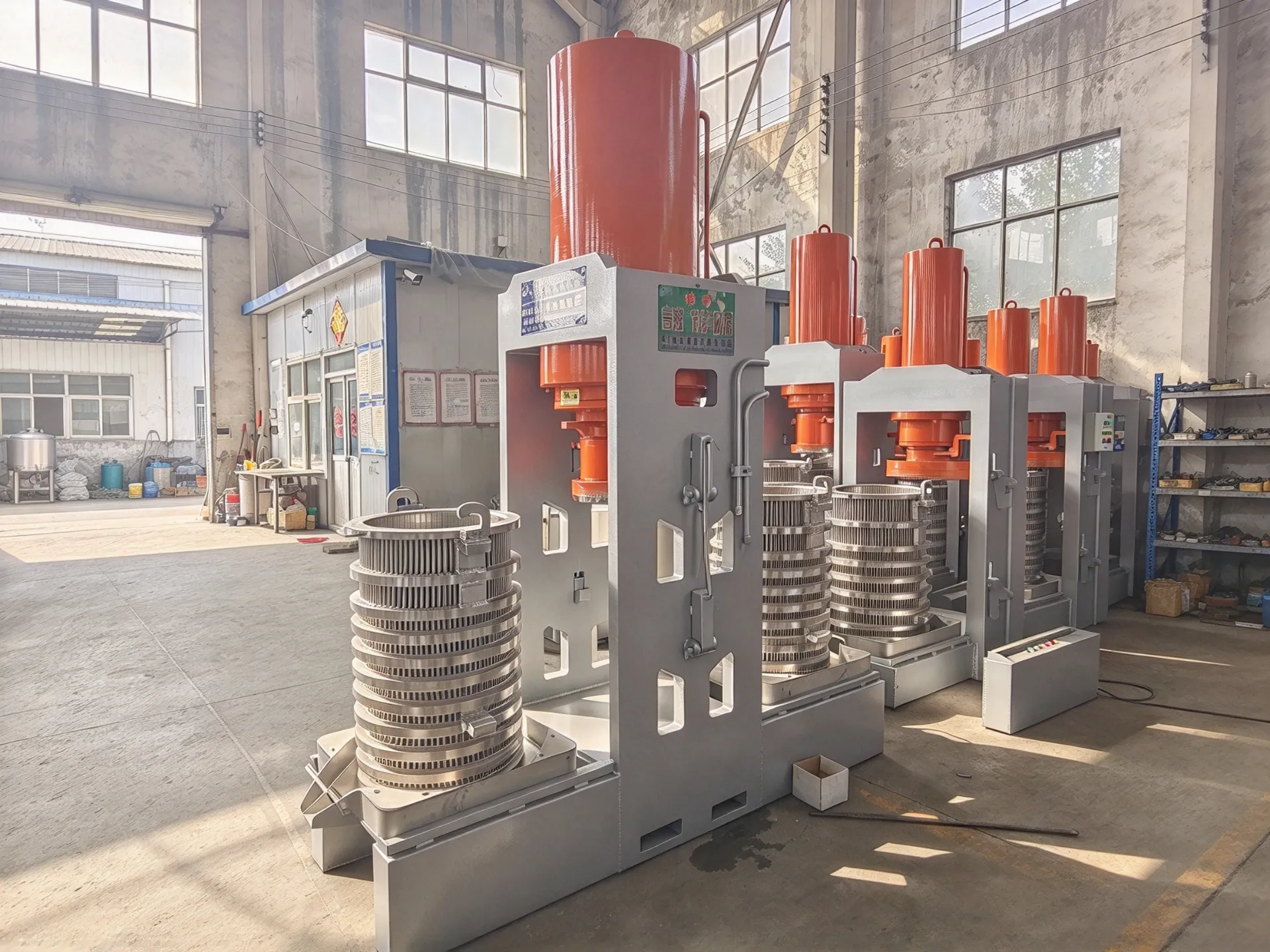
The HN426 Cold Press Hydraulic Oil Press, Inside and Out
HN426 Specifications
| Model (Single/Double) | HN426 Simple / HN426 Double |
| System Pressure | 70 MPa |
| Pressing Force | 500 Tonnes |
| Motor Power | 2.2 KW |
| Machine Weight (Single/Double) | 2,4 / 2,7 Tonnes |
| Cylinder Outer Diameter | 426 mm |
| Piston Inner Diameter | 320 mm |
| Tabung Press Standard Inner Diameter | 390 mm (customizable) |
| Tabung Press Standard Height | 800 mm (customizable) |
| Cylinder Standard Stroke | 850 mm (customizable) |
| Overall Dimensions (Single/Double) | 1200×1200×2750 / 2100×1200×2750 mm |
| Cake Surface Pressure | 42 MPa |
| MOQ | 1 Set |
HN426 Materials
| Part | Material & finish |
|---|---|
| Hydraulic cylinder | Ø426 mm cylinder assembly, pressure-tested before assembly |
| Press barrel | Bar-type slotted barrel — extracts ~2–3% more oil than drilled barrels |
| Control system | Microcomputer control automates the cycle from feeding to cake discharge |
| Frame | 3 cm thick steel plate frame |
The bar-type slotted barrel drains oil faster and clearer than conventional drilled barrels. Food-grade stainless steel barrels are available for premium edible oils such as virgin coconut oil.
How Much Can It Press Per Day?
Batch Cycle & Output
| Cold pressing | ~2 h per batch — low temperature keeps aroma & nutrients in the oil |
| Hot pressing | 30–40 min per batch, after roasting |
| Residual oil in cake | 6–8% typical with the bar-type slotted barrel |
Cold-press cycles are longer by design — premium cold-pressed oil sells at a higher price. Actual output depends on seed, batch size and staff rhythm — not a guaranteed figure. Tell us your seed and daily target and we will calculate your throughput.
Cold Press or Hot Press? Both Built In
| Cold pressing | No roasting — natural color, aroma and nutrients stay in the oil; the premium segment: coconut, walnut, apricot kernel |
| Hot pressing | Roast first for higher yield and richer aroma — the everyday segment |
| One machine | Switch between the two processes on the same press — serve both markets from one machine |
Power & Installation
Runs on a standard 380V / 50Hz supply (2.2 kW motor); other voltage standards can be customized. Generator-friendly: a 5.5 kVA generator is enough for areas with unstable grids. No special foundation needed.
Which Model Fits Your Mill?
| Model | Force | Cake pressure | Barrel Ø (standard) | Configuration | Best for |
|---|---|---|---|---|---|
| HN300 | 300 t | 42 MPa | Ø300 mm | Single / double barrel | Smaller batches (~60 kg), tightest budget |
| HN325 | 325 t | ≈27 MPa | Ø390 mm (customizable) | Single / double barrel | Small & mid-size mills, all-purpose |
| HN365 | 365 t | 30 MPa | Ø390 mm (customizable) | Single / double barrel | Higher daily volume, hard seeds |
| HN426 | 500 t | 42 MPa | Ø390 mm (customizable) | Single / double barrel | Cold press business: coconut, walnut, premium oils |
| HN500 | 620 t | 52 MPa | Ø390 mm (customizable) | Single / double barrel | Hardest in-shell materials |
HN426 or HN325/HN365? If most of your batches are cold-pressed premium oils — coconut, walnut, apricot kernel — the HN426’s 500-ton force protects yield and quality. For all-purpose hot pressing at higher daily volume, see the HN365.
Premium Oilseeds That Deserve the HN426 Cold Press
Cold pressing suits high-value oils. Common materials on the HN426 include coconut, walnut, apricot kernel, sesame, peanut, flaxseed, rapeseed and tea seed — hard-shell materials are its specialty. Reference yields:
Yield by Seed (hot pressing unless noted)
| Seed | Yield | Notes |
|---|---|---|
| Peanut | 40–50% | Rich aroma, golden oil |
| Sesame | 42–54% | Roast & press direct |
| Sunflower seed | 40–50% | Clean, crush, roast |
| Flaxseed | 35–40% | Hot or cold |
| Rapeseed | 35–45% | High-yield, fragrant |
| Tea seed | 15–35% | Clear color, pure aroma |
| Soybean | 12–18% | Hot or cold |
| Walnut | 55–65% cold | Crush raw, press cold |
| Castor seed | 40–60% | Hot pressing |
| Palm fruit | 20–25% (fresh fruit bunch) | Small-batch hot pressing — confirm your process with us |
| Coconut | 30–40% cold | Stainless barrel option |
Figures are gross oil yield per 100 kg of prepared raw material (cleaned, crushed/roasted before pressing), from factory tests and production records. Actual yield varies with variety, moisture, temperature and preparation. Not on the list, or unsure about your material? Ask us for a material test — send us a sample.
Every Seed Needs a Different Line
| Seed | Typical line |
|---|---|
| Coconut (cold) | Crusher → HN426, press without roasting |
| Walnut (cold) | Crusher & color sorter → HN426, no roasting |
| Sesame (hot) | Drum roaster → HN426 |
| Peanut (hot) | Crusher → roaster → HN426 |
Tell us your seed and daily target — we will list the exact equipment. Full lineups per seed: oilseed processing solutions.
Cold pressing needs clean, well-conditioned material — we will list the exact pre-processing equipment for your seed. For the hardest in-shell materials see the HN500; for all-purpose pressing on a tighter budget, the HN325.
Equipping a Cold-Press Workshop Around the HN426
A typical cold-press line around the HN426: seed cleaner & color sorter → crusher (gentle, no heat) → moisture conditioner → the HN426 → oil filter press (filters solids out of the crude oil for clear, sellable oil). No roaster needed in a cold-press line. Browse the full equipment range or send us your raw material — we will list the exact models.
Delivery, Warranty & Support
| Standard build lead time | 15–25 working days + sea freight |
| Custom build (e.g. stainless barrel) | 30–45 days + sea freight |
| Pre-shipment test | 48-hour continuous full-load test before every shipment |
| Warranty | 1 year + lifetime technical support — installation and operation guided by video call / WhatsApp |
| Spare parts | Common parts in stock, express shipped worldwide |
Frequently Asked Questions
What is the oil yield of the HN426 hydraulic oil press?
The oil yield depends on the raw material. For example, sesame yields 42-54%, peanuts 40-50%, and rapeseed 35-45%. The HN426's 500-ton pressing force and bar-type slotted tabung press design achieve approximately 2-3% higher yield (based on Haonuo factory tests with graded sesame and peanut at 6-8% moisture; results vary with seed variety and preparation) than traditional drilled tabung press presses.
What raw materials can the HN426 press?
The HN426 can press sesame, peanut, rapeseed, sunflower seed, flaxseed, tea seed, soybean, cottonseed, and more. It is especially designed for cold pressing hard-shell materials like walnut kernels, in-shell walnuts, and apricot kernels.
How long does one pressing cycle take?
Cold pressing requires longer cycle times to preserve oil quality at low temperatures. A typical cold pressing cycle takes approximately 2 hours per batch depending on the material and desired cake dryness. Hot pressing (with pre-roasting) completes in 30-40 minutes. The actual cycle time depends on factors like seed moisture content, desired cake dryness, and pressing temperature. The microcomputer control system automates the entire process from feeding to cake discharge.
What is the recommended raw material moisture content for cold pressing?
For cold pressing, the optimal moisture content range is 7-9%. This moisture level ensures smooth oil extraction while maintaining low-temperature conditions. Proper moisture control is critical — too high causes oil emulsification and yield loss, while too low increases friction and reduces throughput.
What pre-processing equipment is needed for cold pressing?
Cold pressing requires careful pre-processing steps including seed cleaning and color sorting to remove impurities, dehulling for high-shell-content materials with shell removal rate at least 95 percent, moisture conditioning to reach optimal 7-9 percent moisture, and gentle crushing to break seeds without generating heat below 60 degrees Celsius. Unlike hot pressing, cold pressing does not involve roasting, preserving natural nutrients and flavors.
What is the difference between single and double tabung press configurations?
A single tabung press press processes one batch at a time. A double tabung press press has two tabung press on sliding rails — while one tabung press is pressing, you can load the other, nearly doubling your throughput. We recommend the double tabung press for commercial and industrial operations.
What power supply does the HN426 require?
The HN426 requires 2.2 KW motor power and runs on a standard 380V/50Hz supply. The electrical system can be customized to match your local power standards — simply specify your voltage when ordering.
How many workers are needed to operate the machine?
Only 1-2 workers are needed. The microcomputer control system automates the pressing cycle, and the 4-hook cake removal mechanism makes unloading easy even after overnight pressing.
What warranty do you provide?
We provide a 1-year warranty covering all manufacturing defects, plus lifetime technical support. Spare parts are available from stock.
How is the machine shipped and how long does delivery take?
The machine is shipped in a wooden crate via sea freight. Delivery to most Asian ports takes 15-20 days, to African ports 25-35 days, and to South American ports 30-40 days. This is in addition to production time — 15-25 working days for standard models and 30-45 days for custom or special configurations (shipping time additional).
Do you provide installation and training?
Yes, we provide detailed installation manuals, video tutorials, and remote technical guidance. For large orders, we can send a technician to your facility for on-site installation and training at cost.
What certifications does the machine have?
All machines undergo 48-hour continuous full-load testing before shipment.
Can the tabung press size be customized?
Yes, tabung press inner diameter and height can be customized to match your specific material and batch size requirements. Common customizations include larger tabung press for bulk materials and food-grade stainless steel tabung press for edible oil production.
What is the residual oil rate in the cake?
The residual oil rate in the cake is typically 6-8% for most materials with our bar-type slotted tabung press design, compared to 10-12% with traditional drilled tabung press presses. This means you extract approximately 2-3% more oil (based on Haonuo factory tests with graded sesame and peanut at 6-8% moisture; results vary with seed variety and preparation) from every batch.
Can the machine operate on generator power?
Yes, our machines are fully compatible with generator power. For the HN426, we recommend a minimum 5.5kVA generator. The machine starts easily and runs stably on generator power, making it suitable for areas with unreliable electricity supply such as rural Nigeria, Kenya, and other African regions.
Do you provide voltage customization for different countries?
Yes, the electrical system can be customized to match your local power supply. Simply specify your local voltage when ordering.
How quickly can I get spare parts in Africa or the Middle East?
We maintain stock of all common spare parts (seals, filter cloth, hydraulic oil, control panel components). Standard parts ship promptly via DHL/FedEx, arriving in 5-7 days to most African and Middle Eastern countries.
Related Products
GET YOUR HN426 FACTORY PRICE
Tell us your seed and daily target — our engineers will confirm whether the HN426 fits your market, recommend single or double barrel, check the lead time, and quote within one business day.